travel
Poland — LGBTQ+ guide
Community, safety, legal reality and where to find support across Poland.
About
Poland: An LGBTQ+ Travel and Culture Guide
Poland can be difficult to summarise from an LGBTQ+ perspective. It is a country where queer communities organise large equality marches, run cultural spaces and build visible local networks—while national law still leaves major gaps in relationship recognition, family rights and protection from discrimination.
For an LGBTQ+ traveller, Poland is neither a country that should be dismissed as universally hostile nor one where legal equality can be taken for granted. Experiences vary considerably between large cities, smaller towns and different regions.
This guide covers the legal situation, queer-friendly destinations, Pride events, safety and community resources to help you plan an informed trip.
Is Poland safe for LGBTQ+ travellers?
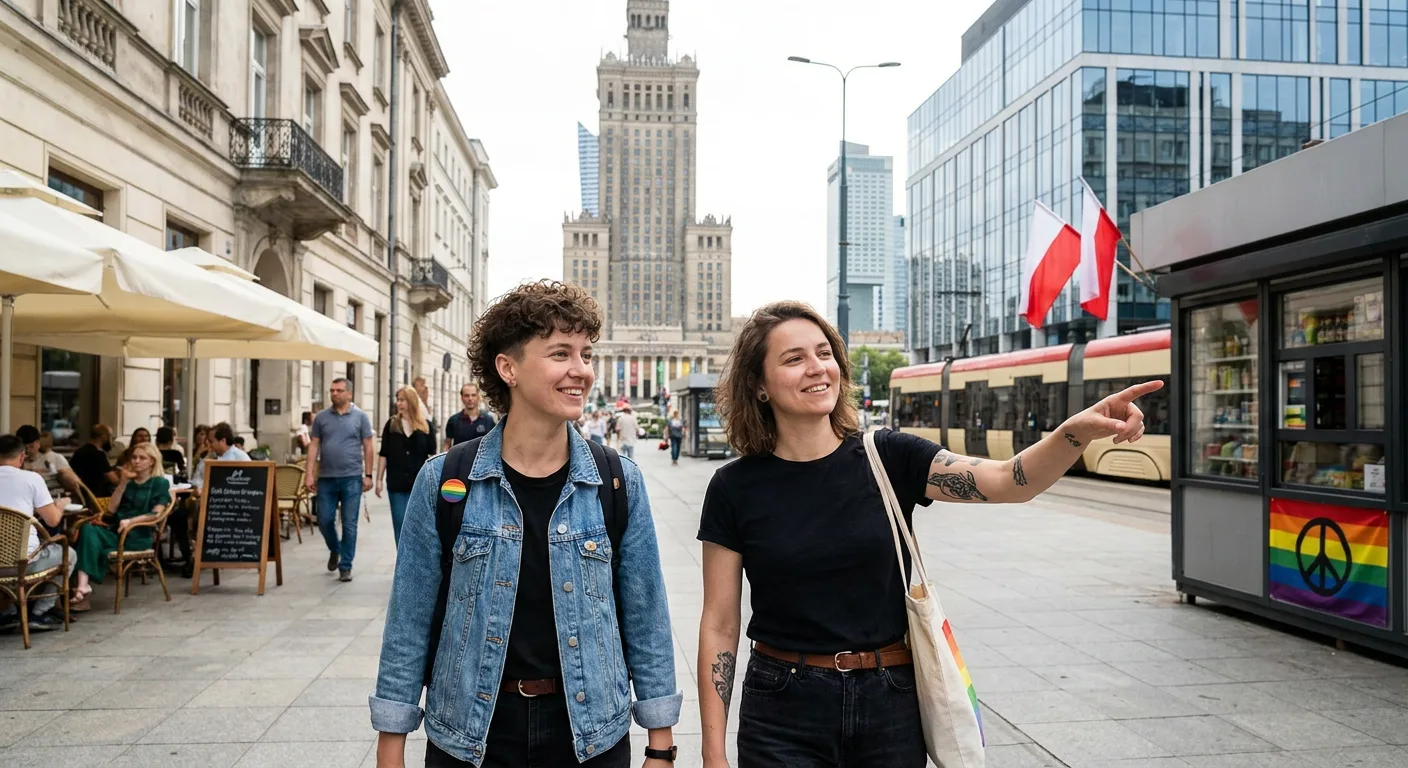
Most LGBTQ+ visitors travel around Poland without serious problems, particularly in major cities and established tourist areas. Warsaw, Kraków, Poznań, Wrocław and Gdańsk all have visible LGBTQ+ communities and host equality marches.
However, social attitudes are mixed. Queer people may encounter staring, comments, verbal harassment or hostility, especially outside central urban areas. Same-sex couples may choose to be more cautious about public affection late at night, around intoxicated crowds or in less familiar neighbourhoods.
This does not mean you need to hide throughout your trip. It means paying attention to your surroundings and making decisions that match your own comfort level.
In an emergency, call 112, the general emergency number available throughout Poland and the European Union.
LGBTQ+ rights in Poland
Consensual same-sex relationships are legal in Poland. However, the country continues to rank near the bottom of the European Union for LGBTQ+ legal and policy protections.
As of July 2026:
Same-sex couples cannot marry in Poland.
Poland does not offer a general domestic registered-partnership system for same-sex couples.
Same-sex couples face significant gaps in family and parental rights.
Legal gender recognition exists but remains complicated and has been criticised by LGBTQ+ organisations.
Protection against discrimination is incomplete.
LGBTQ+ organisations and public equality events operate legally.
The remaining local government declarations commonly known as “LGBT-free zones” were repealed by 2025.
A major legal development occurred after the Court of Justice of the European Union ruled that EU countries must recognise same-sex marriages legally concluded in another member state for the purpose of exercising rights under EU law. Warsaw registered its first foreign same-sex marriage in May 2026.
However, this did not introduce marriage equality within Poland. On 17 July 2026, President Karol Nawrocki vetoed legislation that would have granted limited legal rights to unmarried couples, including same-sex partners.
The legal position is therefore developing and can be confusing. Check the latest information from ILGA-Europe’s Poland profile and the Polish organisation Campaign Against Homophobia before relying on relationship recognition for healthcare, residency, inheritance or other legal matters.
Warsaw: Poland’s largest queer centre
Warsaw has the country’s biggest and most varied LGBTQ+ scene. Queer life is spread across clubs, bars, cultural organisations, events and community initiatives rather than contained within one official gay district.
The city is home to the annual Parada Równości, or Warsaw Equality Parade, which has taken place since 2001. It combines Pride celebration with demands for equal rights and wider social inclusion.
Warsaw is a good first destination for travellers looking for:
Larger LGBTQ+ events
Queer nightlife
Community organisations
Cultural and political events
English-speaking social spaces
A wider choice of venues
Connections to other Polish cities
Central areas such as Śródmieście are generally convenient for visitors because of their transport links, restaurants and proximity to cultural attractions. Neighbourhoods including Praga, Powiśle and parts of Mokotów also have creative and alternative scenes, although specific venues can change quickly.
Warsaw is additionally home to QueerMuzeum, created by Lambda Warszawa to document and celebrate LGBTQ+ history and culture in Poland.
Kraków: history, tourism and queer community
Kraków is one of Poland’s most visited cities. Its historic centre, Wawel Castle, Kazimierz district and extensive cultural programme make it an easy destination to combine with queer events.
The city has an active LGBTQ+ community and holds an annual equality march. Kazimierz is particularly popular for cafés, independent venues and nightlife, although it should not be described as an exclusively queer neighbourhood.
Kraków can feel internationally oriented in its central areas, but it is also located in a more socially conservative region. Tourist districts and community events may feel open while experiences elsewhere can differ.
Check current venue listings before travelling. Small queer venues sometimes move, close or change their programme, while mainstream bars may host LGBTQ+ nights only on selected dates.
Poznań: visible and community-minded
Poznań has developed a reputation for an active, locally rooted queer community. The city hosts Poznań Pride and an annual equality march, accompanied by cultural, educational and social events.
Jeżyce is a particularly lively neighbourhood known for independent cafés, restaurants and community-focused businesses. Poznań’s official city platform has highlighted the area’s visible queer community and queer-run venues.
Poznań may appeal to travellers who want:
A manageable city size
A strong local community
Independent venues
Pride activities beyond nightlife
Good rail connections
A less tourist-heavy experience than Kraków
Wrocław, Gdańsk and other cities
Wrocław
Wrocław is a large university city with an active cultural scene, equality events and LGBTQ+ initiatives. Its compact centre, islands and riverside areas make it well suited to a weekend trip.
Gdańsk
Gdańsk combines Baltic history, coastal travel and an increasingly visible LGBTQ+ community. The wider Tricity area—including Gdańsk, Sopot and Gdynia—offers beaches, nightlife and cultural events.
Sopot has a strong summer-party identity, although a generally liberal tourism atmosphere should not be confused with consistently queer-centred nightlife.
Łódź
Łódź is known for post-industrial architecture, film culture, art and creative communities. Its queer scene is smaller than Warsaw’s but connected to the city’s alternative cultural life.
Katowice and Silesia
Katowice has undergone significant cultural redevelopment and hosts LGBTQ+ initiatives and equality events. The wider Silesian region contains both progressive urban communities and more conservative areas, so experiences can vary significantly over short distances.
Lublin, Toruń and smaller cities
Equality marches now take place in cities across Poland, including places without a large permanent queer nightlife scene. These events are often more political and locally significant than major metropolitan Pride celebrations.
The organisation Miłość Nie Wyklucza maintains a directory of LGBTQ+ organisations and equality marches in Poland.
Pride and equality marches in Poland
Polish Pride events are most commonly called Marsz Równości—Equality March—rather than simply Pride.
These marches combine celebration with political demands concerning:
Relationship recognition
Protection from hate crime
Trans rights and healthcare
Inclusive education
Family rights
Mental health
Freedom from discrimination
Safety in public life
Warsaw hosts the country’s best-known Parada Równości, while many other cities organise their own independent marches.
Dates change annually, and some cities hold events outside June. Always confirm details through the official organiser rather than relying on an old travel calendar.
Smaller marches may attract visible counter-protests or require a larger police presence. Follow organiser guidance, remain aware of exits and avoid engaging directly with hostile groups.
Finding queer venues and events
Poland does not have one reliable permanent list of LGBTQ+ venues. Clubs close, cafés change ownership and some events appear temporarily in mainstream spaces.
For current information, check:
SAFO events and Community Map
Local LGBTQ+ organisations
Official Equality March pages
Verified venue social media
Queer cultural collectives
Recent community reviews
Women-centred and sapphic event organisers
Search terms that may help include:
klub LGBT — LGBTQ+ club
wydarzenia queerowe — queer events
Marsz Równości — Equality March
impreza dla kobiet — party for women
wydarzenia LGBTQ+ — LGBTQ+ events
Do not assume every venue labelled “gay” is equally welcoming to queer women, trans people or non-binary visitors. Read recent reviews and look for clearly stated inclusion policies.
Travelling as a queer woman or same-sex couple
Two women booking one hotel room is unlikely to cause difficulty in major cities or tourist destinations. International chains, modern apartments and established hotels are generally accustomed to diverse guests.
Public affection deserves more individual judgement. Holding hands in central Warsaw, Kraków or Poznań may pass without comment, particularly during Pride. The same behaviour in a quiet town, on late-night transport or near an intoxicated group may draw unwanted attention.
Useful precautions include:
Booking accommodation with recent inclusive reviews
Avoiding isolated transport stops late at night
Using licensed taxis or recognised ride-hailing services
Sharing your live location with someone you trust
Keeping your accommodation address available offline
Moving away rather than answering hostile comments
Reporting immediate threats through 112
Your identity is not the problem. Caution is simply a way of managing an environment where acceptance is uneven.
Considerations for trans and non-binary travellers
Trans and non-binary people may face additional difficulties involving documents, airport security, healthcare and gendered facilities.
If the name or gender marker on your travel documents differs from your appearance, carry any supporting documentation you normally use when travelling. Medication should remain in its original packaging, accompanied by a prescription or medical letter when appropriate.
Gender-neutral public toilets are not consistently available. Larger cultural venues, universities and community spaces may offer more inclusive facilities, but this should not be assumed.
For current trans-specific information and support, visit Fundacja Trans-Fuzja, which provides advocacy as well as psychological and legal assistance for trans, non-binary and intersex people in Poland.
Language and communication
English is widely understood in major cities, particularly among younger people and in hotels, restaurants and tourist attractions. In smaller towns or formal institutions, English availability may be more limited.
A few useful Polish phrases include:
Dzień dobry — Good morning / Good afternoon
Dziękuję — Thank you
Proszę — Please / You’re welcome
Czy mówi Pan/Pani po angielsku? — Do you speak English?
Potrzebuję pomocy — I need help
Proszę zadzwonić pod 112 — Please call 112
Zostaw mnie w spokoju — Leave me alone
Gdzie jest najbliższy szpital? — Where is the nearest hospital?
Polish uses heavily gendered grammar. You may hear different word forms depending on the speaker’s gender. Some non-binary Polish speakers use alternative or neutral forms, but these are not yet universally understood.
LGBTQ+ organisations and support
Campaign Against Homophobia
Kampania Przeciw Homofobii, commonly known as KPH, is one of Poland’s leading LGBTQ+ rights organisations. It works on advocacy, public education and strengthening the national LGBTQ+ movement.
Lambda Warszawa
Lambda Warszawa provides LGBTQ+ psychological, legal and community support. It also offers assistance for LGBTQ+ migrants and refugees.
Check its website for current contact details and service eligibility before visiting or calling.
Fundacja Trans-Fuzja
Trans-Fuzja supports trans, non-binary and intersex people through advocacy, education and access to psychological and legal assistance.
Miłość Nie Wyklucza
Miłość Nie Wyklucza—Love Does Not Exclude—campaigns for marriage equality and provides information about LGBTQ+ organisations and initiatives across Poland.
How to support Poland’s queer community
If you visit Poland, consider supporting queer-owned businesses, independent cultural projects and local organisations. Attend an exhibition or community discussion in addition to a party. Donate directly when you can.
Polish LGBTQ+ communities have built visible, creative and resilient networks despite years of political hostility and incomplete legal protection. Queer Poland is not merely a nightlife category for tourists. It is a living community shaped by activism, art, friendship and a persistent refusal to disappear.
Should LGBTQ+ travellers visit Poland?
Yes—with informed expectations.
Poland offers beautiful cities, excellent food, complex history, strong transport links and queer communities worth meeting. Large cities can provide welcoming and memorable experiences, especially around equality marches and cultural events.
At the same time, legal equality remains unfinished and social acceptance is inconsistent. Research current conditions, choose accommodation carefully and adjust public visibility according to your surroundings.
Poland’s queer reality contains celebration and struggle at the same time. Understanding both will make your visit safer, richer and far more honest.
Frequently asked questions
Is being LGBTQ+ legal in Poland?
Yes. Same-sex relationships are legal, and LGBTQ+ organisations and public equality marches operate legally. However, protections and family rights remain incomplete.
Is same-sex marriage legal in Poland?
Same-sex couples cannot marry under Polish domestic law. Following an EU court ruling, Poland must recognise certain same-sex marriages legally concluded in another EU member state, but the practical and legal situation continues to develop.
Can two women share a hotel room in Poland?
Yes. Same-sex couples commonly book accommodation together, particularly in major cities and tourist destinations. Check recent reviews if you are concerned about a particular property.
Which Polish city has the largest LGBTQ+ scene?
Warsaw has the largest and most varied scene. Poznań, Kraków, Wrocław and Gdańsk also have active LGBTQ+ communities and equality events.
Does Poland have Pride events?
Yes. Warsaw hosts Parada Równości, while cities across the country organise Marsze Równości, or Equality Marches. Dates vary each year.
Is public affection safe for same-sex couples?
Experiences vary by location and situation. Central areas of major cities are generally more accepting, but discretion may be sensible late at night, around intoxicated groups or in unfamiliar smaller towns.